How Authors Get Paid for Ku Reads
Kindle Unlimited (KU), a subscription service through Amazon that allowed readers unlimited access to books for only $x a calendar month, was unveiled past Amazon in July 2014. The reception by readers was by and large positive, finally a Netflix for Books! The reaction from authors and publishers was mixed. Kindle Unlimited was doing to independent authors what Spotify did to musicians. By offering their work for complimentary to subscribers, they were potentially lowering the revenue that an author or publisher could make from each book. In this article we explore how KU has evolved over the by 5 years and its current bear on on authors.
Kindle Unlimited & KDP Select: A History
Since the inception of KDP Select, at that place has always been a KDP Select Global Fund, which is a pot of money that goes to authors whose books are downloaded for complimentary through Amazon'south eBook programs. Authors who enrolled their eBooks in KDP (Kindle Direct Publishing) Select prior to the launch of KU could take their books downloaded for free by Kindle owners who were allotted one free eBook per month through the Kindle Owners Lending Library. In the days prior to KU, the Global Fund totaled around $1 million, and was divided proportionally amongst the authors who had their books downloaded.
In July 2014 with the introduction of KU, the Global Fund increased to $2.4 M, and over the next year as more than readers signed up for KU and more authors enrolled in KDP Select, that Global Fund increased to $11.5 M by July 2015, and today sits right around $25 K.
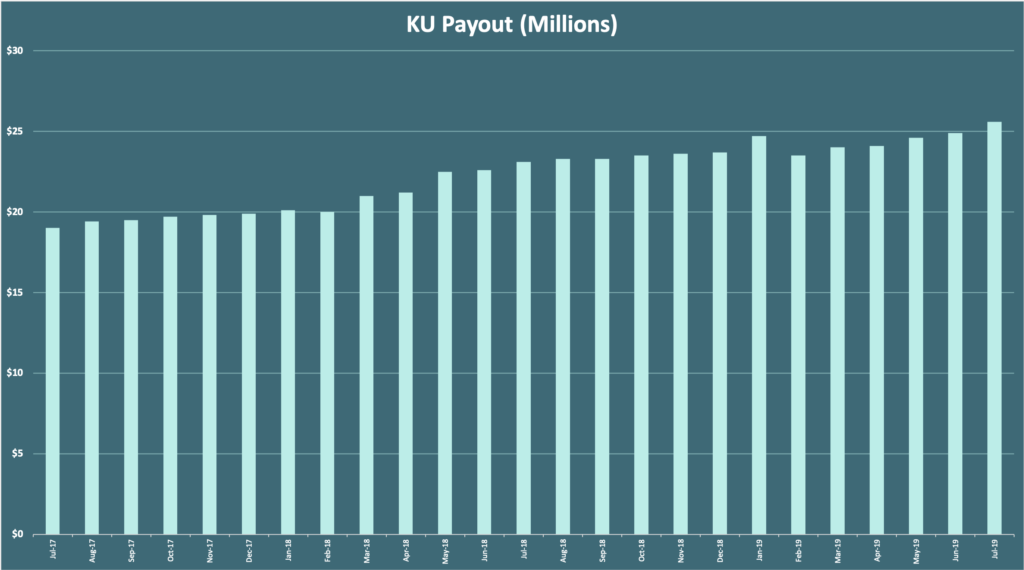
A whopping $267.9 Yard was paid out to authors through the KDP Select Global Fund in 2018. If the pot stays at its current size ($25.6 1000000 per month) for the balance of 2019, Amazon will pay out $299.4 M to authors this yr. It is possible that the Global Fund will go along to abound in the remaining months of 2019, which would make the total Global Fund payout for 2019 north of $299.iv K.
For the kickoff twelvemonth of KU, the payouts were simple: Each writer was paid every fourth dimension someone downloaded and read at least 10% of their book.
When KU was a year onetime, in June 2015, Amazon announced that they would begin paying participating authors by pages read, instead of by the number of books downloaded. At the same time, they introduced KENPC (Kindle Edition Normalized Page Count), which deemed for type size and line spacing to prevent anyone from cheating the system and artificially making their books longer. Amazon calculated the payout per page by beginning with their monthly KDP Select Global Fund and dividing it by the total number of (KENP) pages read. That offset month it was decreed that each page was worth $0.005779.
As more than readers and more authors entered into the KU system, the Global Fund size did not recoup for the increasing number of pages read every calendar month, then the payout per folio read dropped steadily in 2015.
In January of 2016, Amazon announced still another change in how they were going to pay authors with the introduction of KENPC v2.0 (Kindle Edition Normalized Page Count). This was supposed to standardize for boosted spacing and text features. Some authors saw their page counts, and thus their total potential payout per volume, drop, while others saw them ascent. Amazon claimed that the boilerplate change across all KDP titles would be nether 5%, but private authors saw up to ten% changes in folio length.
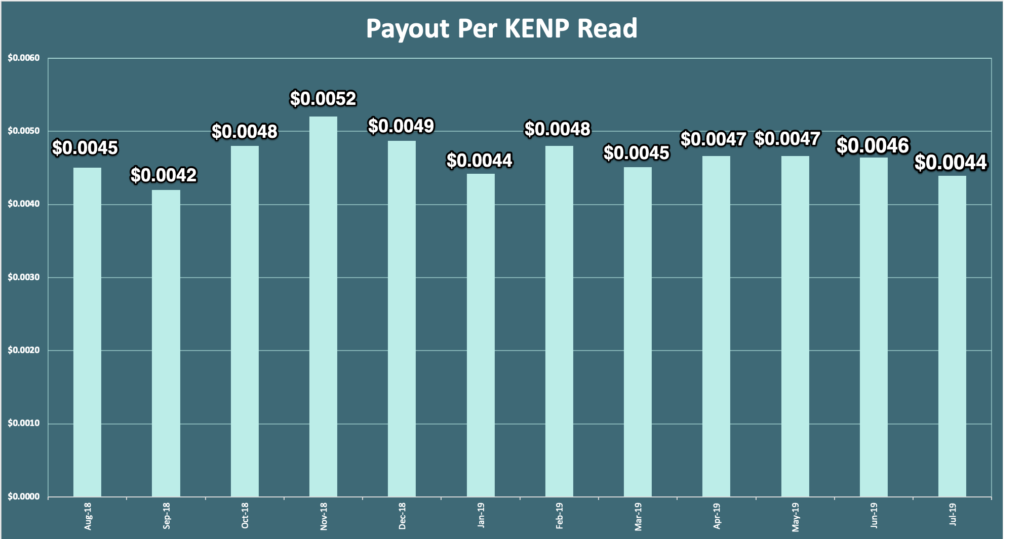
An additional change implemented in V2.0 was the capping of payouts at folio 3,000 for longer titles. This affected mostly dictionaries and large reference books but did accept some implications for larger boxed sets as well. Since these changes, the payout per page has increased support toward $0.005 per page.
Have a expect at how these changes have affected payouts from the past year:
Calculating Payout by Book
Under KU, using July 2019's payout numbers, these are the maximum payouts per book based on total pages read:
| KENP Pages Read | Payout Per Page* | Max Payout |
| 150 | $0.004394 | $0.75 |
| 300 | $0.004394 | $1.fifty |
| 450 | $0.004394 | $2.25 |
| 700 | $0.004394 | $3.fifty |
| one,000 | $0.004394 | $v.00 |
| iii,000 | $0.004394 | $fifteen.00 |
| 6,000 | $0.004394 | $15.00 |
*based on payout numbers from July 2019
Looking at these numbers, it is easy to run into why many authors were upset by the modify to pay per page. Earlier KU, if you wrote a 150 page eBook, and priced it at $ii.99 you would make $2.09 (after Amazon'southward 30% royalty) off of a auction of that volume and you would realize that acquirement every bit before long as a reader downloaded the book. Nether KU, that same book nets you $0.75, and that is only once a reader completes the entire book, which may happen within 24 hours or 6 months of the reader borrowing the book. Additionally, as an author, you lot practice not know what the payout per page will be until the post-obit calendar month, so it's hard to determine what the max. value of your volume in KU is in whatsoever given month.
Authors exercise have a choice of whether or not their book is included in KU. An author can but opt-out of KU altogether by not enrolling their book in KDP Select. This decision proves agonizing for many authors, and there are authors who make skillful arguments for both sides.
Hugh Howey, a successful indie author, offers some perspective in his weblog post Why KU Curt Fiction Yet Makes Sense. He argues that the KENP arrangement is leveling the playing field among indie authors. The amount of piece of work that goes into writing 60,000 words is the same, regardless of whether or not yous publish those 60,000 words every bit one novel or vi, x,000 word short stories. Under the KENP system, both scenarios are compensated as, instead of being skewed in favor of short stories, which were often priced the aforementioned equally total-length novels before. Howey is supportive of Amazon, and sung their praises in a contempo interview with Digital Volume World:
"Kindle Unlimited is just one example of the enormous sums of money an author misses out on past going with a major publisher. Nosotros're talking $150,000,000 a year going directly to authors, and if you sign with a major publisher, you are taking yourself out of that puddle." – Hugh Howey
However, some authors argue that inclusion in KDP Select (and by extension, KU) authors are losing out on other revenue streams and becoming increasingly more than reliant on Amazon.
Controversies
Kindle Unlimited has sparked its fair share of complaints and controversies.
From a promotion and payment perspective, the biggest downside to KU from the start has been that authors no longer get paid for books that readers borrow and never read them. We all have that stack of books that we keep telling ourselves we want to read, but never seem to get to. In the early days of indie eBook authorship, if your cover and blurb were good enough to prompt a sale, then yous got paid. At present the game has inverse and is rewarding increasingly college quality, engaging content. Equally contest increases, covers and blurbs become more than of import to make ebooks stand out from the crowd, with the crux of success coming from the content of a book and the quality of its storytelling.
The near notable and well-nigh recent controversy concerned the placement of the table of contents in books enrolled in KU. Some authors were placing a link at the showtime of their eBooks which directed the reader to a tabular array of contents that lived at the back of the book. Since the number of pages read past a reader (which is what the payout is based on) is measured by noting the furthest page in a volume that a reader views, some believed that authors were cheating the system past preemptively pushing readers to the end of their books. It turns out that this was not every bit impactful equally many believed.
How Exercise Authors Drive KU Borrows?
The same marketing tactics that piece of work for selling books also work for driving KU borrows:
- Promote your title to readers (through your email list, Facebook or Google ads, features on deal sites)
- Drive enough sales or download volume to ascension in the bestseller charts
- Action on the title spurs Amazon'due south algorithm to recommend your book to other readers with like tastes
- Halo sales continue afterwards your promotion has run; KU borrows turn into KENP read
- Run another promotion 90 days later once momentum declines
KU has 2 fundamental perks for indie authors who are actively marketing their titles:
- Information technology is idea that Amazon gives preferential treatment to KU titles, although at that place is no definitive proof. A glance through the Kindle Summit Charts shows a large portion of the best performing books equally eligible through KU. Perhaps this is merely because a KU borrow counts the same as a normal auction or download, so it is easier for these titles to climb the charts. The outcome of this is discussed in the most contempo Writer Earnings report.
- The major publishing houses don't publish their books through the KU programme, so the competition inside the KU program (which includes the books listed in the Kindle Inaugural Bargain charts, and elsewhere) are other indies or small presses. The major traditional publishers are not currently competing.
The primary difference when marketing a championship enrolled in KU is how quickly yous can measure out the results of your efforts. For a title not enrolled in KU measurements is simple: authors watch their sales graph spike so watched halo sales come through in the following days. Authors tally up the full earnings from the promotion and compare it to the fourth dimension and money spent actively marketing the title.
The standard formula
RETURN = Total Sales – Amazon Royalty – Marketing Cost
For a championship that is enrolled in KU, in that location is an additional component to measure: KENP read. The claiming here is twofold:
- Readers who infringe a title during the promotion may non read that volume until 6 months after. So there is an all-encompassing time lag between the promotion and the results of the promotion.
- Authors don't know what the payout per page volition be until the following calendar month. So it is difficult to ascribe a value to pages read that exercise come through in the days following the promotion.
The KU formula
RETURN = (Full Sales – Amazon Royalty) + (KENP pages read * KENP payout rate) – Marketing Price
Many authors make a all-time guess past using the prior calendar month's payout per page to get to an approximate value of the KENP read in the weeks following a promotion. Sophisticated authors will look back at promotions over a 3 or half dozen month window to amass the full effect, and the corresponding full cost of their promotional activity, to account for the lag.
What's Next for Amazon KDP Select and Kindle Unlimited?
Kindle Unlimited has changed the style that many people read books. By giving independent authors an loonshit in which they tin can sell their books without the competition of mainstream publishers, KU has empowered them to find audiences in new ways. But all the while, Amazon reminds authors that they agree the keys to the coffers, and can always change the rules. It'south impossible to predict what new perks and programs Amazon will release in the coming years, simply beingness at the height of the eBook and volume markets appears to be a top priority.
Authors nevertheless take control over many things: whether to enroll in KDP Select at all, the packaging of each book and the quality of the content within. Successful authors focus on these elements and experiment with programs like KDP Select to determine the best path to success for each of their titles.
Source: https://www.writtenwordmedia.com/amazon-kdp-kindle-unlimited/
0 Response to "How Authors Get Paid for Ku Reads"
Post a Comment