Art History How Was the Art of Eastern and Western Roman Empires Similar
Beginnings of Byzantine Fine art and Architecture
To Start: Defining the Byzantine Catamenia
The term Byzantine is derived from the Byzantine Empire, which developed from the Roman Empire. In 330 the Roman Emperor Constantine established the city of Byzantion in modern twenty-four hours Turkey as the new capital of the Roman empire and renamed it Constantinople. Byzantion was originally an ancient Greek colony, and the derivation of the proper name remains unknown, just nether the Romans the name was Latinized to Byzantium.
In 1555 the High german historian Hieronymus Wolf first used the term Byzantine Empire in Corpus Historiæ Byzantinæ, his collection of the era's historical documents. The term became popularized among French scholars in the 17th century with the publication of the Byzantine du Louvre (1648) and Historia Byzantina (1680), only was not widely adopted by fine art historians until the 19thursday century, every bit the distinctive fashion of Byzantine architecture and art in mosaics, icon painting, frescos, illuminated manuscripts, small-scale calibration sculptures and enamel work, was defined.
The Byzantine Empire lasted until 1453 when Constantinople was conquered by the Turkish Ottoman Empire. Byzantine art and architecture is commonly divided into three historical periods: the Early Byzantine from c. 330-730, the Heart Byzantine from c. 843-1204, and Tardily Byzantine from c. 1261-1453. The political, social, and artistic continuity of the Empire was disrupted by the Iconoclastic Controversy from 730-843 and then, again, by the Period of the Latin Occupation from 1204-1261.
The Roman Empire
In the era leading up to the founding of the Byzantine Empire, the Roman Empire was the virtually powerful economic, political, and cultural force in the world. A polytheistic society, Roman religion was deeply informed by Greek mythology, as Greek gods were adopted into the Roman mos maiorum, or "way of the ancestors," viewing their own founding fathers as the source of their identity and worldly power. At the aforementioned fourth dimension, as the empire absorbed the deities of the peoples they conquered as a way of supporting borough stability, the monotheism of Christianity, which starting time appeared in Roman-held Judea in the ist century, was seen as a political and civil threat. The Emperor Nero instituted the first persecution of Christians, as he blamed the sect for the Great Fire of Rome in 65, and subsequent emperors followed suit.
In 303 the Roman Emperor Diocletian instituted the Swell Prosecution, during an era when political leaders, including Constantine, were engaged in a war, driven past competing claims to exist Diocletian's successor. Facing a battle with his rival Maxentius, legend has information technology that Constantine converted to Christianity considering of a vision. Described by the historian Eusebius, "he saw with his own optics in the heavens a trophy of the cross arising from the light of the sun, carrying the bulletin, In Hoc Signo Vinces (In this sign, you shall conquer)." Marking his soldier's shields with the Chi Rho, a symbol of Christ, Constantine was victorious and, subsequently, became emperor. His 313 Edict of Milan legalized the do of Christianity, and in 324, he moved to create a new majuscule in the East, Constantinople, in guild to integrate those provinces into the empire while simultaneously creating a new eye of art, culture, and learning.
Early Christian Art
Creating frescoes, mosaics, and panel paintings, Early Christian art drew upon the styles and motifs of Roman art while repurposing them to Christian subjects. Works of art were created primarily in the Christian catacombs of Rome, where early depictions of Christ portrayed him as the classical "Good Shepherd," a young man in classical apparel in a pastoral setting. At the aforementioned time, meaning was ofttimes conveyed past symbols, and an early iconography began to develop. Every bit the Edict of Milan was followed past the Emperor Theophilus I'south 380 edict establishing Christianity equally the official faith of the empire, Christian churches were built and busy with frescoes and mosaics. The classical sculptural tradition was abandoned, equally it was feared that figures in the round were too reminiscent of pagan idols. In the first 2 centuries of the Byzantine Empire, as the historians Horst Woldemar Janson and Anthony F. Janson wrote, there was, "No articulate-cut line between Early Christian and Byzantine art. E Roman and West Roman - or, as some scholars prefer to phone call them, Eastern and Western Christian - traits are difficult to divide before the sixth century."
Early on Byzantine Fine art and Emperor Justinian I

The flowering of Byzantine architecture and art occurred in the reign of the Emperor Justinian from 527-565, as he embarked on a edifice campaign in Constantinople and, subsequently, Ravenna, Italia. His near notable monument was the Hagia Sophia (537), its name meaning "holy wisdom," an immense church with a massive dome and light filled interior. The Hagia Sophia's many windows, colored marble, brilliant mosaics, and aureate highlights became the standard models for subsequent Byzantine architecture.
To blueprint the Hagia Sophia, burnt downward in a previous anarchism, Justinian I employed two well-known mathematicians, Isidore of Miletus and Anthemius of Tralles. Isidore taught stereometry, or solid geometry, and physics and was known for compiling the offset collection of the works of Archimedes, a classical Greek engineer and scientist. A mathematician, Anthemius wrote a pioneering study on solid geometric forms and their relationships while arranging surfaces to focus low-cal on a single point. The two men drew upon their knowledge of geometrical principles to engineer the Hagia Sophia's big dome as they pioneered the use of pendentives. The triangular supports at the corners of the dome'due south square base of operations redistributed the weight, making it possible to build the largest dome in the globe until the St. Peter's Basilica dome, which also employed pendentives, was completed in Rome in 1590.
Hiring x,000 artisans to build and decorate the Hagia Sophia, Justinian I also established innumerable workshops in icon painting, ivory etching, enamel metalwork, mosaics and fresco painting in Constantinople. As art historians H.Due west. Janson and Anthony F. Janson wrote, during his reign, "Constantinople became the creative besides as political capital of the empire....The monuments he sponsored have a grandeur that justifies the claim that his era was a golden age." As the Empire was at its well-nigh geographically expansive during Justinian's reign, Byzantine fine art and architecture influenced modern twenty-four hours Turkey, Greece, the Adriatic regions of Italia, the Middle East, Spain, Northern Africa, and Eastern Europe. While other structures, particularly his Chrysotriklinos, the purple palace reception room, were equally influential, that building, like other early structures in Constantinople, was later destroyed. As a outcome, the all-time examples of Early on Byzantine innovation can exist seen in Ravenna, Italian republic.
Ravenna, Italy
Justinian I appointed his protégé Maximianus, a lowly and somewhat unpopular deacon, every bit Archbishop of Ravenna, where he acted every bit a kind of implicit regent for the Emperor within Italian republic. In 547, Maximianus completed the construction of San Vitale, a cardinal-programme church using a Greek cross within a square that became a model for subsequent architecture. The shallow dome, placed upon a drum, used terra cotta forms for the first time every bit construction material, while the interior's exquisite mosaics and sacred objects, including the Throne of Maximianan (mid-11th century) defined the Byzantine mode.
Having survived almost intact since its consecration, the interior of the Church of San Vitale created an effect of intricate splendor, with every inch richly decorated. Large mosaics depicting the Emperor and Empress established Byzantine limerick and figurative techniques, as the realistic depictions of classical fine art were abased in favor of an emphasis upon iconographic formality. The alpine, thin, and motionless figures with almond shaped faces and wide optics, posed frontally, against a gold background became the instantly recognizable definition of Byzantine fine art.
Acheiropoieta and Icons

Early on Byzantine artists pioneered icon painting, minor panels depicting Christ, the Madonna, and other religious figures. Objects of both personal and public veneration, they developed from classical Greek and Roman portrait panels and were informed past the Christian tradition of Acheiropoieta. Acheiropoieta, meaning, "made without hands," was an image believed to have been miraculously created. According to tradition, St. Luke the Evangelist, one of the original twelve apostles, painted the image of the Madonna and Child Jesus when they miraculously appeared to him. The Monastery of the Panaghia Hodegetria in Constantinople was congenital to house a now-lost icon believed to be St. Luke's painting. As art historian Robin Cormack noted, it became "possibly the almost prominent cult object in Byzantium." These miraculous images influenced the development of iconographic types, as St. Luke's icon became known as Hodegetria, meaning "She Who Points the Fashion," as the Madonna pointed to the Kid Jesus.

Acheiropoieta were often credited with gimmicky miracles. The Prototype of Edessa was believed to take come up to the divine assistance of the urban center of Edessa in its 593 defense against the Persians. The central image of Christ's head, known as the Mandylion in the Byzantine tradition, recalled the image of Christ'southward face imprinted on a cloth while he walked to the identify of his crucifixion. Worshippers believed they were in the presence of the divine, equally art historian Elena Boerck wrote, "Icons, different idols, have their ain agency. They're interactive images, in which the divine is present." Nonetheless, every bit the worship of icons became a ascendant feature of Byzantine life, a violent and subversive theological debate developed.
Iconoclastic Controversy
By the 8th century, the Byzantine Empire was under force per unit area and ofttimes at state of war, and in this tense climate the controversy over the spiritual validity of icons erupted. Motivated past the belief that contempo events, including military defeats and a volcanic eruption in the Aegean Sea in 726, were God's penalisation for what he chosen, "a craft of idolatry," the Emperor Leo III officially prohibited religious images in 730 and launched a movement called Iconoclasm, significant "breaking of icons." Long standing theological debates over the divine and human nature of Christ and a ability struggle betwixt the imperial state and the church stoked the controversy. The Iconoclasts felt that no icon could portray both Christ's divine and human nature, and to convey merely one aspect of Christ was a heresy. Those who supported icons argued that, dissimilar idols which depicted a false god, the images but depicted the incarnate Christ and that the images derived their authority from Acheiropoieta. By inserting himself into the debate, the Emperor substituted majestic prescript for religious dominance, undercutting the influence and power of the church building. Subsequently, the country violently supressed monastic clergy and destroyed icons.
 th century), portrayed Byzantine Empress Theodora and her son Michael III as the Hodegetria, a Madonna and Child icon presiding over the restoration of icons." data-initial-src="/images20/photo/photo_byzantine_art_8.jpg" width="235" height="300" src="https://www.theartstory.org/images20/photo/photo_byzantine_art_8.jpg">
The era came to an end with a alter in majestic ability. Following the death of her married man, the Emperor Theophilus, in 842, the Empress Theodora took the throne and, as she was passionately devoted to the veneration of icons, summoned a council that restored icon worship and deposed the iconoclastic clergy. The occasion was historic at the Feast of Orthodoxy in 843, and icons were carried in triumphal procession back to the diverse churches from which they had been taken. Nonetheless, the Iconoclastic Controversy had a notable impact on the after development of art, equally the councils that restored the worship of icons also formulated a codified organization of symbols and iconographic types that were too followed in mosaics and fresco painting.
Eye Byzantine 867-1204
The Eye Byzantine era is often chosen the Macedonian Renaissance, every bit Basil I the Macedonian, crowned in 867, reopened the universities and promoted literature and art, renewing an interest in classical Greek scholarship and aesthetics. Greek was established as the official language of the Empire, and libraries and scholars compiled extensive collections of classical texts. The Ecumenical Patriarch of Constantinople, Photios was not only the leading theologian but has been described by the historian Adrian Forescue every bit "the greatest scholar of his time." His Bibliotheca was an important compilation of almost three hundred works by classical authors, and he played a leading role in seeing Byzantine civilisation every bit rooted in Greek civilization. The result was, as Janson and Janson wrote, "an almost antiquarian enthusiasm for the traditions of classical art," displayed in works like the illuminated manuscript, the Paris Psalter (c. 900) a book of Biblical psalms that included full page illustrations from the life of King David and that employed a more realistic handling of both the figures and the landscape.
Throughout Europe, Byzantine culture and art was seen as the meridian of aesthetic refinement, and, equally a result, many rulers, fifty-fifty those politically antagonistic to the Empire, employed Byzantine artists. In Sicily, which had been conquered by the Normans, Roger II, the first Norman King, recruited Byzantine artists and, as a event, the Norman architecture that developed in Sicily and United kingdom of great britain and northern ireland, following the Norman Conquest in 1066, profoundly influenced Gothic architecture. Hundreds of Byzantine artists were too employed at the Basilica of San Marco in Venice when construction began in 1063. In Russia, Vladimir of Kiev converted to the Orthodox Church upon his wedlock to a Byzantine princess. He employed artists from Constantinople at the St. Sophia's Cathedral he congenital in Kiev in 1307. Notable examples of Macedonian Renaissance art were also created in Hellenic republic, while the influx of Byzantine artists influenced art throughout Western Europe as shown by the Italian creative person Berlinghiero of Lucca's Hodegetria (c. 1230).
The Latin Occupation 1204-1261
Famed for its wealth and artistic treasures, Constantinople was cruelly sacked and the Empire conquered in 1204 past the Crusade Army and Venetian forces under the 4th Crusade. The brutal attack upon a Christian city and its inhabitants was unprecedented, and historians view it as a turning point in medieval history, creating a lasting schism between the Cosmic and Orthodox churches, severely weakening the Byzantine Empire and contributing to its later on demise when conquered by the Turkish Ottoman Empire. Many notable artworks and sacred objects were looted, destroyed, or lost. Some works, like the Roman bronze works of the Hippodrome, were carried off to Venice where they are still on brandish, while other works, including sacred objects and altars also every bit classical bronze statues, were melted down, and the Library of Constantinople was destroyed. Though the Latins were driven out by 1261, Byzantium never recovered its former glory or power.
Tardily Byzantium 1261-1453
Post-obit the Latin Conquest, the Late Byzantine era began to renovate and restore Orthodox churches. Even so, as the Conquest had decimated the economic system and left much of the city in ruins, artists employed more than economic materials, and miniature mosaic icons became popular. In icon painting, the suffering of the population during the Conquest led to an emphasis upon images of compassion, as shown in sufferings of Christ. Artistic vitality shifted to Russia, Republic of bulgaria, Romania, and Hellenic republic, where regional variations of icon painting adult. Russian federation became a leading middle with the Novgorod School of Icon Painting, led by principal painters Theophanes the Greek and Andrei Rublev. Byzantine art as well influenced contemporaneous art in the W, specially the Sienese Schoolhouse of Painting and the International Gothic Style, equally well as painters like Duccio in his Stroganoff Madonna (1300).
Byzantine Art and Architecture: Concepts, Styles, and Trends
Architectural Innovations
Known for its fundamental programme buildings with domed roofs, Byzantine architecture employed a number of innovations, including the squinch and the pendentive. The squinch used an arch at the corners to transform a square base into an octagonal shape, while the pendentive employed a corner triangular back up that curved upwardly into the dome. The original architectural design of many Byzantine churches was a Greek cross, having four arms of equal length, placed within a square. After, peripheral structures, like a side chapel or 2d narthex, were added to the more than traditional church footprint. In the xith century, the quincunx building design, which used the four corners and a fifth element elevated above it, became prominent as seen in The Holy Apostles in Thessaloniki, Athens, Greece. In improver to the central dome, Byzantine churches began calculation smaller domes around information technology.
Poikilia
Byzantine architecture was informed past Poikilia, a Greek term, meaning "marked with various colors," or "variegated," that in Greek artful philosophy was developed to suggest how a complex and various assemblage of elements created a polysensory experience. Byzantine interiors, and the placement of objects and elements inside an interior, were designed to create ever changing and animated interior as calorie-free revealed the variations in surfaces and colors. Variegated elements were also accomplished by other techniques such equally the employment of bands or areas of aureate and elaborately carved stone surfaces.
For instance the basket capitals in the Hagia Sophia were so intricately carved, the stone seemed to dematerialize in low-cal and shadow. Decorative bands replaced moldings and cornices, in effect rounding the interior angles and so that images seemed to flow from i surface to some other. Photios described this surface consequence in ane of his homilies: "It is as if one had entered heaven itself with no one barring the way from any side, and was illuminated by the dazzler in irresolute forms...shining all around like and so many stars, then is 1 utterly amazed. [...] Information technology seems that everything is in ecstatic movement, and the church itself is circumvoluted around."
Iconographic Types and Iconostasis

Byzantine fine art adult iconographic types that were employed in icons, mosaics, and frescoes and influenced Western depictions of sacred subjects. The early Pantocrator, meaning "all-powerful," portrayed Christ in majesty, his right hand raised in a gesture of instruction and led to the evolution of the Deësis, meaning "prayer," showing Christ as Pantocrator with St. John the Baptist and the Virgin Mary, and, sometimes, additional saints, on either side of him. The Hodegetria developed into the later iconographic types of the Eleusa, meaning tenderness, which showed the Madonna and the Child Jesus in a moment of affectionate tenderness, and the Pelagonitissa, or playing child, icon. Other iconographic types included the Human of Sorrows, which focused on depicting Christ'due south suffering, and the Anastasis, which showed Christ rescuing Adam and Eve from hell. These types became widely influential and were employed in Western art also, though some like the Anastasis simply depicted in the Byzantine Orthodox tradition.
Iconostasis, significant "chantry stand up," was a term used to refer to a wall composed of icons that separated worshippers from the altar. In the Heart Byzantine period, the Iconostasis evolved from the Early on Byzantine templon, a metallic screen that sometimes was hung with icons, to a wooden wall composed of panels of icons. Containing three doors that had a hierarchal purpose, reserved for deacons or church notables, the wall extended from flooring to ceiling, though leaving a space at the top so that worshippers could hear the liturgy around the chantry. Some of the most noted Iconostases were developed in the Tardily Byzantine menstruum in the Slavic countries, as shown in Theophanes the Greek's Iconostasis (1405) in the Cathedral of the Annunciation in Moscow. A codification organization governed the placement of the icons arranged according to their religious importance.
Novgorod School of Icon Painting

The Novgorod School of Icon Painting, founded by the Byzantine artist, Theophanes the Greek, became the leading schoolhouse of the Late Byzantine era, its influence lasting beyond the fall of the Byzantine Empire in 1453. Theophanes' work was known for its dynamic vigor due to his brushwork and his inclusion of more dramatic scenes in icons, which were unremarkably only depicted in large-scale works. He is believed to have taught Andrei Rublev who became the most renowned icon painter of the era, famous for his ability to convey circuitous religious thought and feeling in subtly colored and emotionally evocative scenes. In the adjacent generation, the leading icon painter Dionysius experimented with balance between horizontal and vertical lines to create a more dramatic consequence. Influenced by Early Renaissance Italian artists who had arrived in Moscow, his mode, known for pure color and elongated figures, is sometimes referred to as "Muscovite mannerism," as seen in his icon series for the Cathedral of the Dormition (1481) in Moscow.
Carved Ivory
In the Byzantine era, the sculptural tradition of Rome and Greece was substantially abandoned, as the Byzantine church felt that sculpture in the round would evoke heathen idols; nevertheless, Byzantine artists pioneered relief sculpture in ivory, usually presented in small portable objects and common objects. An early example is the Throne of Maximianan (also called, the Throne of Maximianus), fabricated in Constantinople for the Archbishop Maximianus of Ravenna for the dedication of San Vitale. The piece of work depicted Biblical stories and figures, surrounded past decorative panels, carved in different depths so that the near three-dimensional treatment in some panels contrasted against the more shallow two-dimensional handling of others.
In the Middle Byzantine period, ivory etching was known for its elegant and delicate detail, as seen in the Harbaville Triptych (mid-11th century). Reflecting the Macedonian Renaissance's renewed interest in classical fine art, artists depicted figures with more naturally flowing draperies and contrapposto poses. Byzantine ivory carvings were highly valued in the W, and, as, a result, the works exerted an artistic influence. The Italian artist Cimabue'southward Madonna Enthroned (1280-90), a work prefiguring the Italian Early Renaissance's utilize of depth and space, is predominantly informed by Byzantine conventions.
Later Developments - Subsequently Byzantine Art and Architecture
During its almost one k yr span, the Byzantine era influenced Islamic architecture, the art and architecture of the Carolingian Renaissance, Norman compages, Gothic compages, and the International Gothic style. When the Turkish Ottoman Empire conquered Constantinople in 1453, renaming it Istanbul, the Byzantine Empire came to an end. Yet the Byzantine style continued to be employed in Hellenic republic and in Eastern Europe and Russia, where a "Russo-Byzantine" style developed in architecture.
In the mid-1800s, Russia underwent a Byzantine Revival, also called the Neo-Byzantine, which was established as the official manner for churches by Alexander II of Russian federation, who reigned from 1885-1891. The style continued to be used until Earth State of war I, and, following the Russian Revolution of 1917, a number of architects immigrated to the Balkans where churches in the Byzantine Revival mode connected to exist made until later Earth War II. The veneration of icons, and the painting of them, is nonetheless a notable feature of the Orthodox faith, as Orthodox households have a space defended to icons, and churches, renowned for their images, draw worshippers from well-nigh and far.
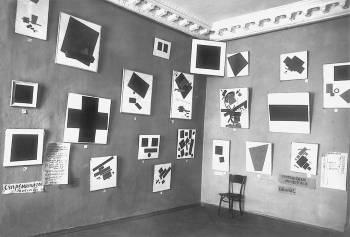
Byzantine icons take continued to exert an influence, existence employed for more traditional religious imagery, such as Luigi Crosio'southward late 19th-century rendering of Lady of Refuge, a popular image among Catholics, just too reframed within mod fine art in works such as Natalia Goncharova's The Evangelists (1911) and other Russian Futurists of the fourth dimension. In particular, Russian Suprematist painter Kazimir Malevich famously exhibited his radically abstruse Black Square (1915) in the corner of the room, a space traditionally reserved for religious icons and referred to as the "red corner." Equally Russian writer Tatyana Tolstaya wrote of this radical act, "Instead of red, black (zero colour); instead of a face, a hollow recess (zero lines); instead of an icon - that is, instead of a window into the heavens, into the light, into eternal life - gloom, a cellar, a trapdoor into the underworld, eternal darkness." In subverting the traditional Byzantine icon, Malevich hoped to comment on the bleak state of modernity.
Contemporary Interpretations of the Style
Contemporary artists working in Byzantine styles and subjects include the Russian Maxim Sheshukov, the Romanaian Ioan Pope, the American architect Andrew Gould, iconographer Peter Pearson, the Canadian sculptor Jonathan Pageau, and the Ukrainian Angelika Artemenko. The Archimandrite, or priest-monk, Zenon Theodor was acclaimed for his 2008 paintings in St. Nicholas Cathedral, in Vienna, Republic of austria, while Greek artist Fikos combines Byzantine murals and icons with his interest in street art, comic volume strips, and graffiti in what he calls "Contemporary Byzantine Painting." In America, the Brooklyn-based Alfonse Borysewicz has been called "1 of the about important religious artists since the French Catholic Georges Rouault" by art historian Gregory Wolfe.
0 Response to "Art History How Was the Art of Eastern and Western Roman Empires Similar"
Post a Comment